

Table of Contents
Employees approve invoices, handle client records, use Microsoft 365, access cloud apps, respond to vendor emails, and work remotely every day. Each action depends on a person recognizing what is normal, what needs verification, and when to stop a workflow before access or money moves.
That is why the benefits of cybersecurity training belong in business continuity planning. According to Verizon’s 2023 Data Breach Investigations Report, 74% of all breaches involve the human factor. Cyber awareness training works best as one layer beside Microsoft 365 security hardening, threat detection, remediation, tested backups, employee coaching, and ongoing advisory support.
David Gracey, Founder & President at Network 1 Consulting, notes: “Employees need to know what to do at the approval screen, login prompt, shared folder, or vendor email, not just what threats look like.”
Benefits Of Cybersecurity Training For Everyday Business Decisions
Training works when it improves routine decisions across finance, operations, HR, and client service. One rushed approval, ticket, or file share can affect payment timing, access rights, customer data, and compliance evidence. Proofpoint found that 71% of surveyed working adults admitted risky actions, and 96% did so knowing the risks.
-
Verify payment changes: Employees pause before approving unexpected banking updates, urgent wire requests, or vendor instructions that bypass the purchase order process.
-
Question risky prompts: Staff recognize unsafe links, attachments, and Microsoft 365 login screens before credentials are entered.
-
Review access requests: Managers check permission changes before tickets are completed, especially when users change roles or need elevated access.
-
Report early signals: Teams escalate suspicious activity instead of working around it, giving IT a clearer path to investigate.
Those habits often reveal larger red flags in MFA, email security, Microsoft 365 configuration, permissions, and incident response planning. Training does not replace technical controls; it shows where those controls need to be tightened.
Cyber Awareness Training In Real Workflows
A finance employee receives a vendor banking change request while a project manager waits on a purchase order approval. The email looks routine, but the sender asks for payment before the next billing run and includes a Microsoft 365 login prompt. Cisco Talos reported that Half of the engagements this quarter involved social engineering, which shows why workflow-level training matters.
What this looks like in practice. An employee verifies invoice changes through an approved contact, not by replying to the email. A remote user reports an unexpected login prompt instead of approving repeated MFA requests. A team member opens a help desk ticket when customer files appear in the wrong shared folder, giving IT a record to investigate rather than a quiet workaround.
Training creates the signal technical teams need to act before a small issue becomes a business interruption. Monitoring, threat detection, employee training, and incident planning all reinforce that response.
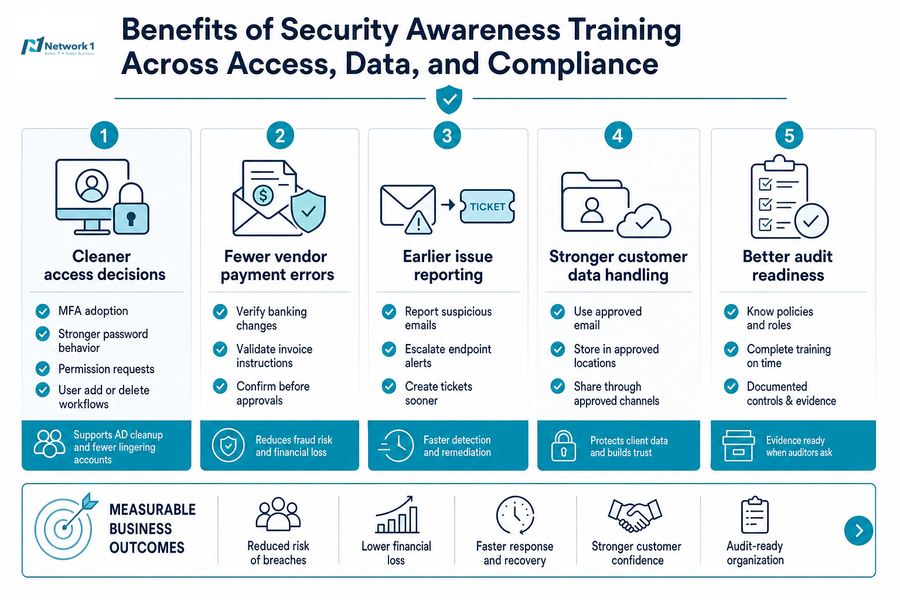
Benefits Of Security Awareness Training Across Access, Data, And Compliance
The benefits of security awareness training become measurable when you tie them to access, data handling, and compliance duties. Research found organizations with effective SAT programs are 8.3 times less likely to appear on public data breach lists annually. In our work, that means connecting training to layered protection such as Network 1 Consulting’s 1-Guard Security Suite, MFA, email protections, Microsoft 365 security hardening, and Active Directory cleanup.
-
Cleaner access change decisions: Employees understand MFA, password behavior, permission requests, and user add or delete workflows. That supports Active Directory cleanup and reduces lingering accounts after a transfer, resignation, or role change.
-
Fewer invoice and vendor errors: Trained employees verify banking changes and unusual invoice instructions before approvals move forward. That protects cash flow, vendor relationships, and audit trails.
-
Earlier issue reporting habits: A suspicious email, repeated login prompt, or endpoint alert becomes a ticket sooner, helping detection and remediation start faster.
-
Stronger customer data handling: Staff use approved email, shared drives, and cloud storage for client files instead of creating unmanaged copies.
-
Better audit readiness evidence: Policy awareness, training records, and documented controls create evidence when auditors ask.
Build Stronger Security Habits
Importance Of Security Awareness Training When Legacy Systems And Cloud Tools Overlap
Many organizations run older systems beside cloud applications, shared drives, remote access tools, and vendor portals. That mix creates confusion about which login prompts are legitimate, where sensitive files belong, who approves access changes, and how employees should report unusual system behavior. The importance of security awareness training becomes clearer when organizations citing lack of end-user or cybersecurity training as a root cause increased from 28% in 2023 to 44% in 2024.
-
Map the workflow: Identify where employees touch sensitive files, approvals, vendor portals, shared drives, and remote access.
-
Clarify ownership: Define who approves access changes before IT completes tickets, especially when legacy permissions and cloud groups do not match cleanly.
-
Plan modernization: Use risk assessments, policy development, infrastructure analysis, and roadmap discussions to decide where training needs stronger technical support.
Then build a repeatable program around those findings, not around generic reminders.
Strengthen Employee Security Decisions
Turn cyber awareness into safer daily workflows. Network 1 Consulting helps align training with Microsoft 365 security, backups, and ongoing protection.
Security Awareness Training That Turns Policy Into Daily Habits
Organizational change is hard because employees are already balancing tickets, approvals, client requests, and deadlines. Training sticks when it follows real work, then reinforces the controls and planning that protect those workflows. A Proofpoint healthcare cybersecurity report found 76% using programs to reduce risk.
-
Start with risky workflows: Review invoice changes, new user access, file sharing, and remote login before expanding into broader topics.
-
Pair with controls: Align training with MFA, email security, endpoint protection, patching, and Microsoft 365 hardening.
-
Simplify reporting paths: Give employees a help desk ticket route for suspicious emails, unexpected login prompts, file-sharing mistakes, and device alerts.
-
Review and adjust: Use onboarding findings, monitoring, annual business reviews, or IT committee meetings to refine the roadmap.
In our onboarding process, this starts with inventorying hardware and software, deploying best practices, applying cybersecurity controls, documenting the environment, and building a long-term IT plan.
Build Training Into A Stronger Security Program
Training has value when it connects to policies, access control, monitoring, threat detection, remediation, backups, and incident planning, with Forrester predicting people will be a primary factor in 90% of data breaches.
Network 1 Consulting has served Atlanta-area businesses for over 25 years and supports more than 128 businesses with employee training, infrastructure analysis, Microsoft 365 security hardening, backups, and VCIO-level planning. Contact us if you want a practical review of the approval screens, login prompts, shared folders, vendor emails, and broader cybersecurity programs your employees rely on every day.
Explore Cybersecurity Services in Atlanta