


Table of Contents
A growing organization runs on connected work: users, cloud apps, vendor portals, customer records, invoices, approvals, and compliance evidence. A network security plan turns those moving parts into clear decisions about who has access, what is monitored, how alerts are handled, and how work continues after an incident.
Tony Rushin, Marketing Vice President at Network 1 Consulting, notes: “Security planning works when every alert, access change, firewall rule, and recovery step has an owner before the business is under pressure.”
That discipline is becoming part of normal operations. By 2027, 75% of CIOs will integrate cybersecurity measures directly into systems and processes. At Network 1, we view security as a business control, tying layered security, firewall management, employee training, threat detection, and remediation to smoother operations, fewer disruptions, and clearer ownership when something goes wrong.
Network Security Plan Example For Executive Visibility
Before you approve tools, budgets, or policy changes, you need a network security plan example that shows what will change in daily work, not just what will be purchased. Our assessment and onboarding process inventories hardware, software, users, and known red flags, then turns those findings into immediate priorities, documented controls, and a practical roadmap.
-
Asset and system inventory: Identify servers, laptops, cloud apps, vendor portals, and customer data locations before controls are assigned.
-
Access and firewall rules: Map user roles, approval paths, remote access, and firewall exceptions to actual workflows.
-
Protection and monitoring ownership: Document endpoint protection, alert review, recovery expectations, and who acts when payroll, billing, or customer systems are affected.
Network Security Plan Template That Starts With Risk Ownership
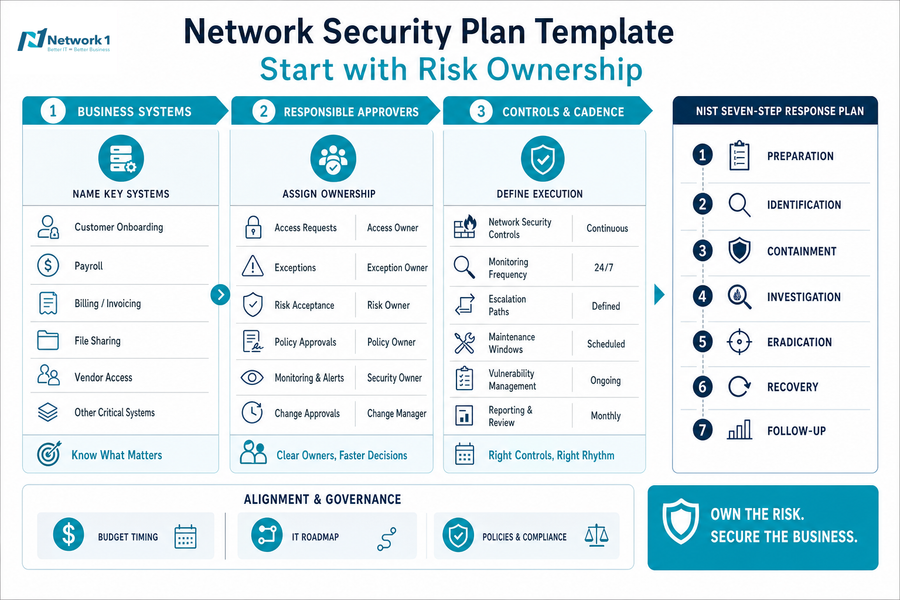
Ownership keeps security work from stalling in approval queues, duplicate tickets, and unclear remediation steps. A useful network security plan template connects controls to customer onboarding, payroll, billing, file sharing, and vendor access, then aligns the work with budget timing and the IT roadmap. NIST frames response as preparation, identification, containment, investigation, eradication, recovery, and follow-up in its seven-step plan.
-
Business systems: Name the systems that process invoices, records, drawings, orders, and approval requests.
-
Responsible approvers: Assign owners for access, exceptions, maintenance windows, and risk acceptance.
-
Controls and cadence: Define security controls, monitoring frequency, escalation paths, and patching windows.
Implementing Network Security Across Users Devices And Vendors
A construction firm shares project drawings with estimators, subcontractors, and field managers from laptops, tablets, and vendor portals. If one user keeps broad access after leaving a project, the issue becomes more than a password problem. It affects bid documents, change orders, deadlines, and customer confidence.
Implementing network security works best when access follows the job being done. Many organizations are rethinking remote access, with 63% moving from a VPN to zero trust network access to reduce risk.
Depending on each client’s needs, that may include the 1-Guard Security Suite, SentinelOne, KnowBe4, 1-Shield managed firewall, and continuous monitoring.
Build A Stronger Security Program
Network Security Proposal Example For Budget And Approval
-
Current red flags identified: A network security proposal example should show exposed systems, weak Microsoft 365 settings, missing patches, unmanaged devices, and findings from the assessment.
-
Business risk by workflow: Tie each issue to billing, client file access, vendor portals, payroll, compliance evidence, or other work that stops when systems are unavailable.
-
Recommended controls and timing: Scope 1-Guard Security Suite, Server Care or Essential Care, firewall management, and user impact by phase so approvals match operational risk.
-
Monthly service scope: Clarify monitoring, patching, support desk coverage, remediation, and one-vendor accountability across hardware, software, cloud, data, process, people, and strategy.
-
Recurring review process: Include roadmap reviews, budget timing, and no-contract flexibility with notice so security planning stays current without a long-term lock-in. For incident readiness, align the review process with NIST’s seven-step plan, from preparation through follow-up.
Sample Network Security Plan For Layered Protection
No single control protects approvals, customer records, Microsoft 365 accounts, workstations, and servers. A sample network security plan should layer prevention, detection, user awareness, and recovery so a missed email clue, compromised account, or failed laptop does not stop invoice processing.
-
Endpoint and user defense: Use 1-Guard Security Suite with SentinelOne and KnowBe4 to support endpoint detection and employee security training.
-
Email and identity controls: Harden Microsoft 365 with 1-Identity MFA, DMARC, DKIM, SPF, and mailbox protections.
-
Firewall and recovery: Manage perimeter rules through 1-Shield managed firewall and confirm recoverability through 1-Vault backup testing.
Implementation Of Network Security Without Disrupting Work
-
Schedule around business deadlines: The implementation of network security should avoid payroll runs, invoice cycles, court filings, and shipping cutoffs whenever maintenance windows allow.
-
Reduce help desk spikes: Communicate password, MFA, and workstation patch expectations before rollout so tickets are useful, not repetitive. Under Essential Care, our Support Desk handles unlimited remote break/fix for end-users and workstations from 7am to 7pm Monday through Friday.
-
Test access before rollout: Confirm remote users, vendor portals, printers, shared folders, and line-of-business applications before broad changes go live.
-
Validate firewall and patch changes: Patch discipline matters because agencies were told to update ALL ASA and Firepower devices, not just public-facing devices. We handle monthly server and workstation patching through defined NOC processes, with firewall management tied to documented change control.
-
Confirm backup recoverability: We test random file restores monthly for 1-Vault Veeam and 1-Vault NSure clients, because backups only matter when files, folders, and systems restore when needed.
Build a Stronger Security Plan
Turn access, monitoring, and response decisions into a practical network security plan with Network 1 Consulting.
Implement Network Security With Monitoring And Remediation Discipline
Alerts become business risk when no one owns triage, escalation, and remediation. To implement network security well, we assign monitoring follow-through, with eyes on alerts starting at 5 am workdays and critical server-down situations addressed before missed orders, delayed approvals, or unresolved tickets spread.
-
Alert review: Suspicious tools, malware, and scanners matter because only one in four affected organizations identified incidents through suspicious activity.
-
Endpoint isolation: Contain infected laptops before shared drives, cloud accounts, or line-of-business apps are touched.
-
Firewall and patch follow-through: Review events, confirm rule changes, push updates, and document remediation steps.
-
Post-incident records: Capture root cause, recovery steps, user impact, and follow-up work so the issue does not return as another ticket.
Network Security Implementation Roadmap For Ongoing Maturity
Changing security processes affects users, approvals, vendors, and recurring work, so the roadmap has to fit the business calendar. We use Annual Business Reviews and IT Committee meetings where useful to keep security aligned with infrastructure age, compliance needs, growth plans, budget timing, and technology refresh decisions.
-
Schedule the assessment: Inventory hardware, software, cloud apps, user access, and current support tickets.
-
Rank the red flags: Separate urgent exposure from planned improvements so budget decisions are easier to defend.
-
Confirm critical systems: Identify payroll, billing, customer records, production dependencies, and vendor portals that need recovery priorities.
-
Approve the baseline: Set required security layers, maintenance windows, and user communication dates.
-
Update the roadmap: Revisit priorities as locations, staff, vendors, regulations, or hardware refresh needs change.
Build A Plan That Supports The Way Your Business Works
A strong security plan protects daily workflows, reduces avoidable downtime, clarifies ownership, and gives you a practical path for budgeting and improvement. It should make approvals cleaner, tickets easier to route, vendors easier to govern, and recovery steps easier to trust.
If you want a grounded review of your current environment, contact Network 1 Consulting. We can assess your current environment, identify priorities, and build a practical roadmap that aligns security with your business goals, all through one trusted technology partner.
Explore Cybersecurity Services in Atlanta